Cybersecurity? It’s here with CyberSecHere — protect, detect, and persevere!
Cyber Security Awareness Session — MES Vasant Joshi College of Arts & Commerce
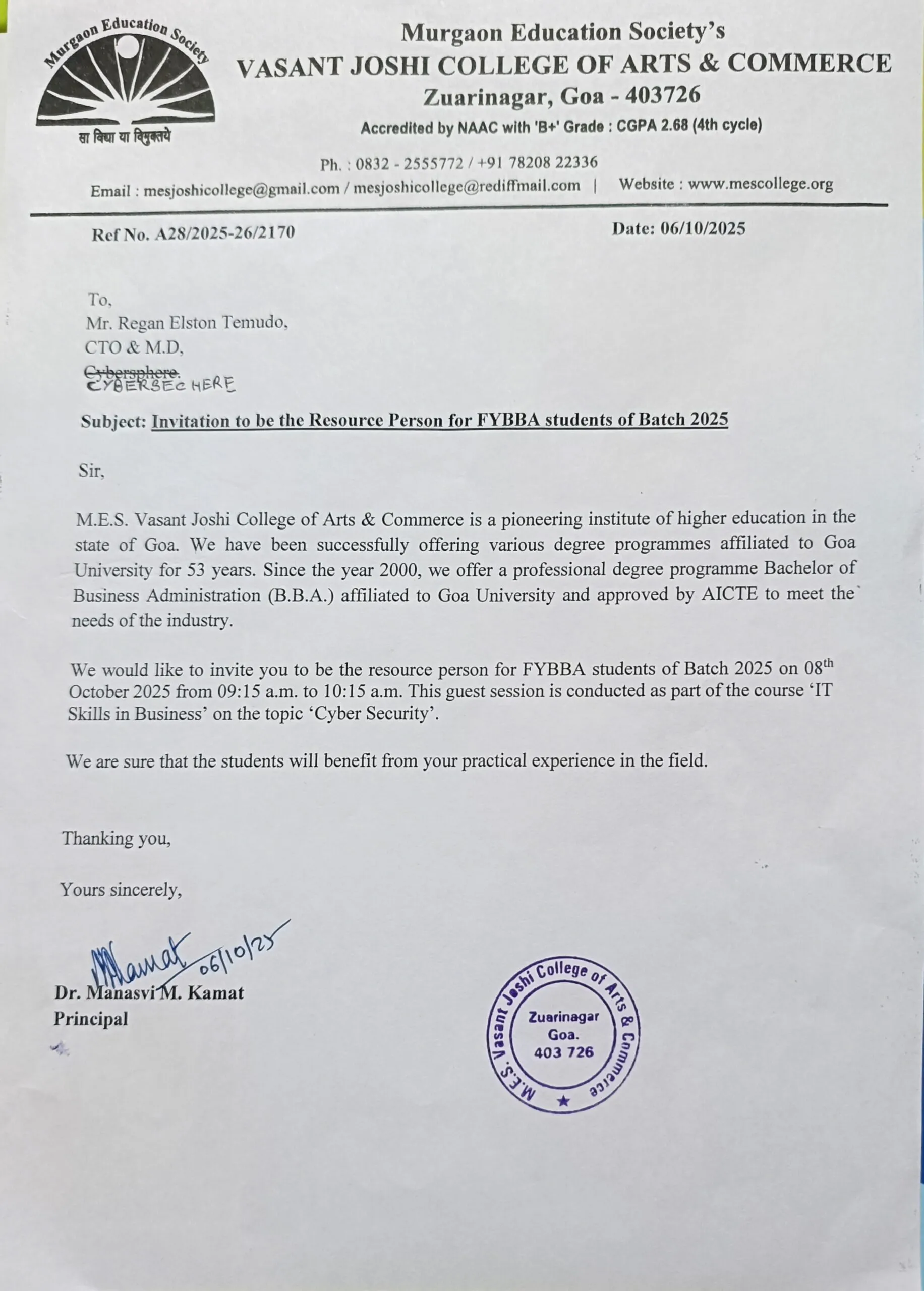
Resource Person: Mr. Regan Elston Temudo, CTO & Managing Director, CyberSechere
Date: 8th October 2025 | Time: 09:15 AM — 10:15 AM
Venue: Prin. M.S. Kamat Seminar Hall, MES Vasant Joshi College of Arts & Commerce, Zuarinagar, Goa.


Session Overview
On 8th October 2025, MES Vasant Joshi College of Arts & Commerce hosted an incisive and practical session on Cyber Security for the FYB.A and B.B.A (Semester I) students. The guest resource person, Mr. Regan Elston Temudo (CTO & M.D., CyberSechere), delivered a compact one-hour lecture and demonstration that combined real-world examples, preventative guidance, and interactive situational exercises.
Acknowledgements (as per the invitation and thank-you images)
We gratefully acknowledge the invitation letter dated 06/10/2025 and the subsequent thank-you letter dated 08/10/2025 issued by the College. — formally requested and recognised Mr. Temudo’s contribution. We extend our sincere gratitude to:
- Dr. Manasvi M. Kamat, Principal, MES Vasant Joshi College
- Ms. Sarah Vaz, Event Co-ordinator
- Shri. Sandeep M. Kadam, Head, Dept. of I.T.
- Dr. Kirti Tyagi, Coordinator, B.B.A.
- All faculty and administrative staff involved in organising the session
Who Attended
The session was attended by FY B.A and B.B.A Semester I students. The classroom was lively and participatory — students engaged through questions, scenario responses, and short live demonstrations. Their attentiveness and practical queries enriched the session and enabled targeted advice that students can immediately implement.
Core Topics Covered by Mr. Regan Elston Temudo
Mr. Temudo addressed a broad range of cyber threats, defensive measures, and safe digital habits. Below is a topic-by-topic summary with concise explanations and recommended mitigations.
-
Phishing
Definition: Fraudulent messages designed to trick users into revealing credentials or sensitive data. Takeaway: Verify sender addresses, avoid clicking suspicious links, hover to inspect URLs. Use email filtering and multi-factor authentication (MFA). -
Financial Frauds
Definition: Scams aimed at stealing money directly (e.g., fake bank messages, investment frauds). Takeaway: Confirm any financial request with the institution directly, never share OTPs or banking passwords, and treat unsolicited financial offers with skepticism. -
Password Hygiene
Definition: Best practices for creating and managing passwords. Takeaway: Use long passphrases, unique passwords per service, and a reputable password manager. Avoid reusing credentials. -
Social Media Dangers
Definition: Privacy leakage, oversharing, and social engineering via social platforms. Takeaway: Restrict profile visibility, audit friend lists, avoid posting sensitive details (location, travel plans, personal identifiers). -
OTP Swap / SIM Swap
Definition: Attackers hijack phone numbers to intercept OTPs for account takeover. Takeaway: Protect SIM with carrier PINs, enable app-based authenticators where possible (e.g., Google Authenticator), and notify providers of suspicious SIM activity. -
Bluesnarfing
Definition: Unauthorized access to information on a Bluetooth-enabled device. Takeaway: Disable Bluetooth when not in use, set devices to non-discoverable, and accept pair requests only from trusted devices. -
UPI Scams
Definition: Unified Payments Interface scams such as QR-code fraud, social engineering, or fake payment prompts. Takeaway: Verify payee details before confirming payments, use bank apps for QR scanning, and avoid UPI notifications prompting action from unknown senders. -
Fake Accounts & Impersonation
Definition: Fraudulent profiles created to deceive or manipulate others. Takeaway: Confirm identities via trusted channels, report impersonations to platform administrators, and refrain from sharing sensitive information with unverified accounts. -
Job Scams & Career Fraud
Definition: Bogus employment offers that demand money or personal data. Takeaway: Validate recruiters and offers, check official company HR channels, never pay for an interview or job placement. -
Fake Loans & Financial Offers
Definition: Predatory loan schemes promising quick credit in exchange for upfront fees or sensitive data. Takeaway: Use regulated lenders only; resist offers requiring advance fees or unusual payment methods. -
Catfishing
Definition: Deceptive romantic or social profiles created to manipulate or extract value from victims. Takeaway: Be cautious of rapid emotional escalation online; verify identities with video calls and independent evidence. -
Card Skimming
Definition: Techniques to copy debit/credit card data at compromised ATMs or point-of-sale terminals. Takeaway: Inspect ATMs for tampering, use chip/e-wallet options, and review bank statements vigilantly. -
And Many More Topics
Mr. Temudo additionally touched on topics such as device hardening, secure backups, safe Wi-Fi use, browser security, ransomware awareness, and practical incident response steps for students who suspect compromise.
Practical Demonstrations & Student Interaction
The session was not merely theoretical. Mr. Temudo provided short practical demonstrations illustrating how phishing links are structured, how malicious payloads are obfuscated, and how a basic credential harvesting attempt is staged. Students were invited to participate in short live exercises and Q&A segments — their interactive questions were insightful and centred on realistic scenarios such as social media privacy, protecting UPI transactions, and recovering a compromised account.
Key Recommendations for Students (Actionable Checklist)
- Enable multi-factor authentication (prefer app-based authenticators over SMS OTP where possible).
- Use a password manager and unique credentials for each site.
- Make regular backups of important academic work and use versioning where available.
- Never share OTPs, banking passwords, or personal identity documents in response to unsolicited messages.
- Keep operating system and application updates current to avoid known vulnerabilities.
- Be cautious of short, urgent messages demanding immediate action — they are frequently social engineering attempts.
- Report suspicious incidents promptly to campus IT or a responsible adult.
Expressing Our Gratitude
CyberSechere and Mr. Regan Elston Temudo extend heartfelt thanks to MES Vasant Joshi College of Arts & Commerce for the invitation and warm hospitality. We particularly appreciate the official invitation 06/10/2025 and the formal thank-you letter, dated 08/10/2025 acknowledging the session. We also thank the organising team — Ms. Sarah Vaz (Event Co-ordinator), Shri Sandeep M. Kadam (Head, Dept. of I.T.), Dr. Kirti Tyagi (Coordinator, B.B.A.), and Principal Dr. Manasvi M. Kamat — for their impeccable coordination and support.
Closing Remarks
The session represents a constructive step toward improving cyber awareness among first-year students. The interactive format and the practical emphasis ensured that attendees left with actionable knowledge and a clearer understanding of online risks and mitigation strategies. CyberSechere looks forward to continued collaboration with the College and remains available for future workshops, advanced technical seminars, and student mentoring initiatives.
Once again, sincere thanks to MES Vasant Joshi College of Arts & Commerce for the invitation and the gracious recognition. We commend the students for their engagement and encourage all attendees to implement the safety measures covered today.